

































Back to: Cardiovascular
Clotting and Atherosclerosis
Normal clot formation
Haemostasis is a physiological response to tissue injury in order to prevent blood loss. It is accomplished by the cooperation between platelets, clotting factors and endothelial cells.
After injury to the endothelium, ECM is exposed and binds platelets via Won Willebrand factor
Activated platelets promote vasoconstriction and form a primary haemostatic plug using cell adhesion molecules, such as the aIIb/b3 integrin.
The injury to the endothelium can also activate the coagulation cascade – a series of proteolytic reactions in which zymogens are sequentially activated.
Thrombin catalyses the conversion of fibrinogen into fibrin monomers, which polymerize to make a clot.
These work with platelets to form a stable secondary haemostatic plug.
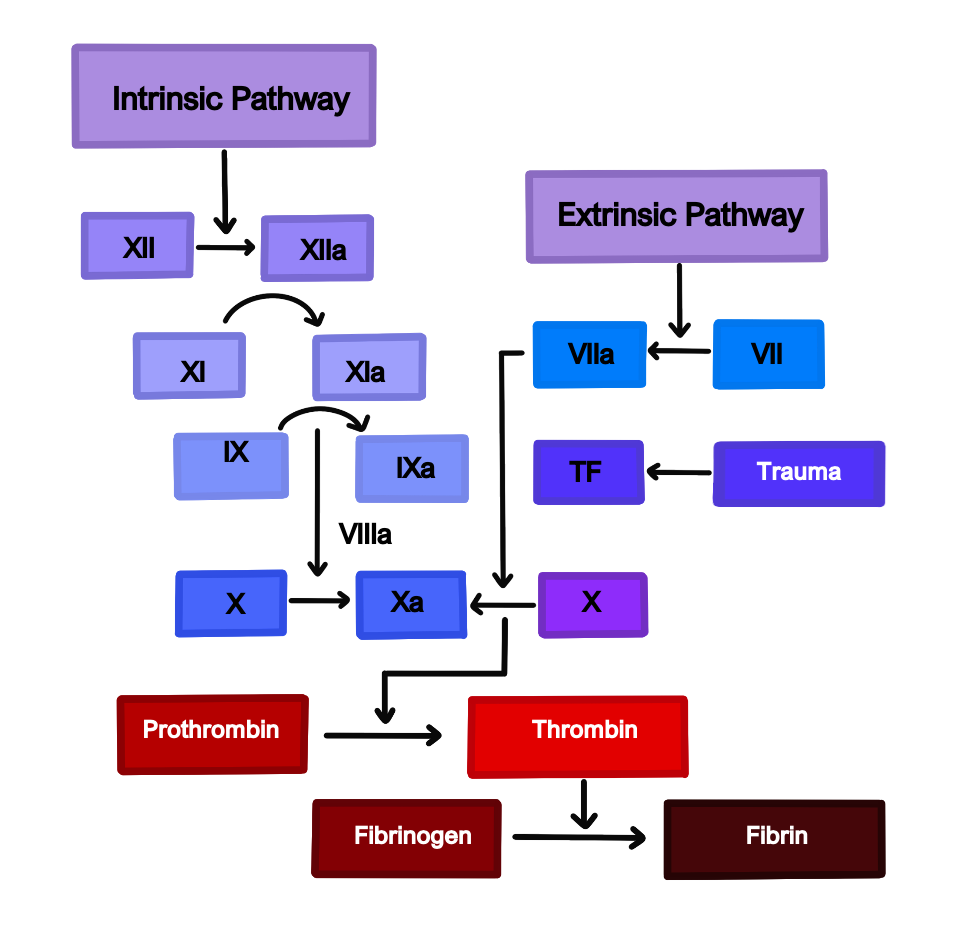
Most coagulation is mediated via the extrinsic pathway, due to tissue factor binding to factor VII.
The intrinsic pathway plays a minor role.
Clotting function is measured using the INR scale.
Gives ratio of time taken for person’s blood to clot: compared to normal clotting time.
If a patient is on warfarin, INR is around 2-3
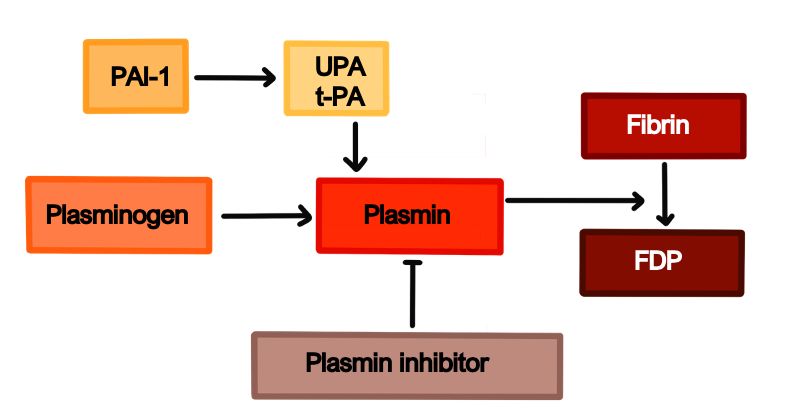
The plamin pathway is activated simultaneously with the fibrinolytic system which works in the opposite fashion:
Most anti-clotting medicine work by producing the serine protease plasmin
Plasmin cuts the fibrin mesh at various places producing fragments that can be cleared by kidney/liver
Also breaks down other clotting factors.
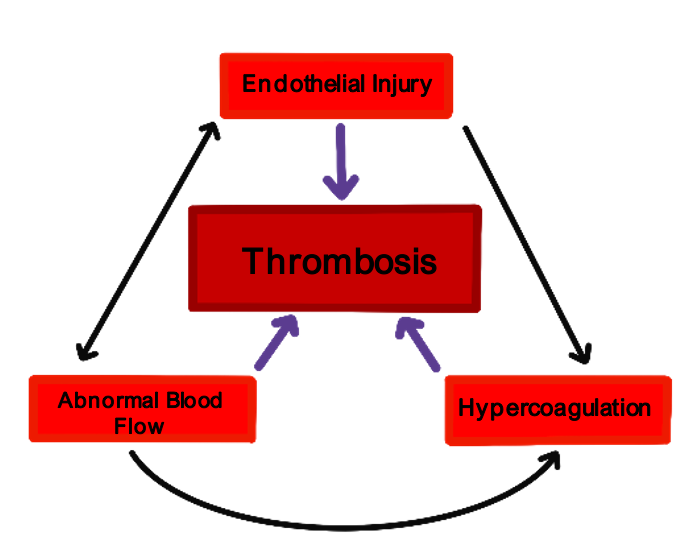
Virchow’s Triad
The chances of a thrombus occurring depend on three types of factors, known as Virchow’s triad.
1) Changes in blood constituents
These lead to an increased tendency to coagulate
Can be genetic – deficiency of antithrombin III or protein C resistance (Factor V Leiden)
Acquired – malignancy, smoking, hyperlipidaemia, oral contraceptive pill
2) Changes in vessel wall
This is due to endothelial cell injury or activation, due to Ischaemia, hypoxia, infection or immunological damage (due to immune complexes)
3) Changes in blood flow
Turbulent flow puts platelets in contact with endothelium and leads to poor delivery of anticoagulants and activation of endothelium
In arteries –> narrowing, heart valve disease, aneurysm, dysrhythmias
In veins –> right sided heart failure, varicose veins, increased viscosity
Atherosclerosis
This refers to a deposition of fatty substances in the tunica intima of arteries and arterioles. Arterial walls consist of 3 main layers:
Tunica intima – endothelial cells linked by tight junctions
Tunica media – contains layers of elastic tissue and smooth muscle cells
Tunica adventitia –connective tissue, nerves, lymphatics and vasa vasorum vessels supplying artery.
It takes a series of steps to develop atherosclerosis
1) Endothelial cell activation
2) Monocyte infiltration into plaque
Monocytes enter and mature into macrophages. They take LDLs and are converted into foam cells
3) Smooth muscle activation
The smooth muscle cells proliferate and migrate into the intima from the media
4) Lipoprotein infiltration
LDL becomes in plaques by Reactive Oxygen Species
5) T cell migration into the plaque
Atherosclerosis Risk Factors
There are 4 main risk factors for atherosclerosis
Hyperlipidaemia
Smoking
Hypertension
Diabetes
Other risk factors
Age
Male – oestrogen is protective in pre-menopausal women
Obesity
Low birth weight
Infection (chlamydia)