



















































Medical Training Pathways
Dear Friend,
Well done for getting through this past week. Monday 15th January is known as Blue Monday which is theoretically the most depressing day of the year. Which means, from this point onwards, it should just get better.
This week, I had a bit more time on my hands, so I’ve been preparing my portfolio for registrar applications next year. I wanted to share with you what medical training pathways look like in the UK, as it is something I didn’t understand till I graduated. Hopefully you find it a useful read.
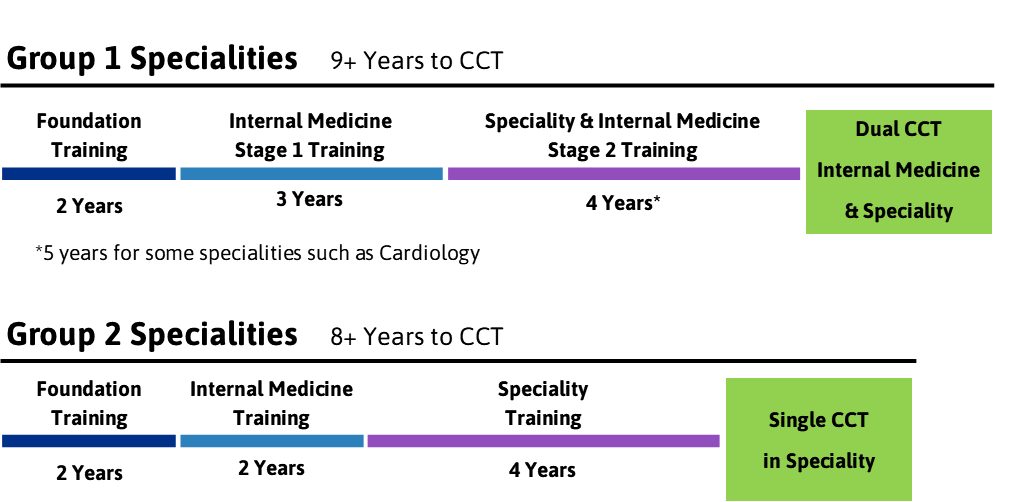
Lets start by having a look at the training pathway for doctors in the UK:
- Foundation training
All doctors in the UK who graduate have to undergo 2 years of foundation training. At this point you are a doctor and you are earning money. Foundation training involves doing rotations of 3/4 months each in a different specialty. FOr example across 2 years you may do the following:
General Surgery – Acute Medicine – Renal Medicine
Gastroenterology – Psychiatry – GP
After this is complete you then apply for further training. It is at this point where you can decide you want to become a GP (3 year training pathway), surgeon (up to 8 years) or do a medical specialty, which I will go through now.
2. Internal medicine training (IMT)
If you decide you want to do a medical specialty (e.g. cardiology, gastroenterology, neurology etc), you then have to undertake internal medicine training. This is up to 3 years in total. In these 3 years you will be rotating through different medical specialties only (so say goodbye to the surgery and psych rotations). The idea is to prepare you to become a registrar. After you complete IMT, you will then apply for specialty training.
There is an important point to be made here. When applying for speciality training, it is important to know whether your specialty is in Group 1 or Group 2.
Group 1 forms most of the major medical specialties (e.g. cardio, GI, neurology, resp etc.) If you are doing this you will need to do 3 years of IMT. In the third year, you are treated like a registrar and will have to manage a medical take. On a night shift, you may be the most senior doctor on the medical team present in the hospital.
Group 2 is composed of other specialities like oncology for example. For these, you only need to do 2 years of IMT, and you will not be required to be the medical registrar in the hospital. As you progress into specialty training, there are also some key differences between the groups.
3. Specialty training
After completing 2 or 3 years, you then specialise in the field you want to become a consultant in. Specialty trianing takes bewteen 4-5 years usually after which you become a consultant. There are some important differences between Group 1 and Group 2 specialities.
For Group 1, alongside training in your field, you will have to dual certify in general medicine. This means being the medical registar working in medical take in A&E and being on the on-call rota.
For Group 2, you are spared for dual accreditation and can solely specialise in your field. This means you do not have to do the general medical on-calls, which many people prefer as it gives a better work life balance.
4. Consultant
After completing your training years and passing exams, you then become a consultant.
I hope this gives some clarity. Of course there are additional programmes for those interested in research. Trainees also take years out to travel etc. But I hope this helps you when you are choosing which specialty you want to do. In particular, take a look at which specialities are included in Group 1 or 2 by clicking the button below.
Drug of the week
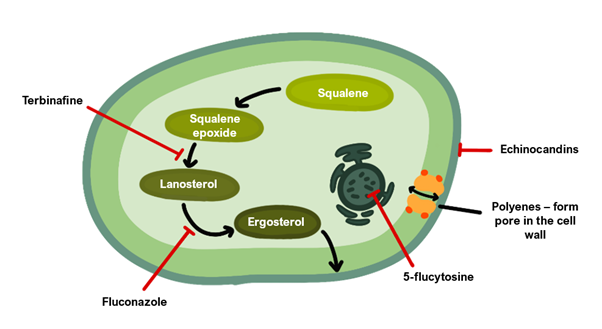
Fluconazole
This is a drug which is used to treat fungal infections.
These inhibit 14a-demethylase which prevents the synthesis of ergosterol in the cell membrane.
The depletion alters fluidity and permeability causing the organism to die.
It can be used as a topical agent, oral tablet as well as given intravenously.
It inhibit liver enzymes CYP450 and so affects the metabolism of other drugs.
Therefore, when prescribing this drug, remember to discuss with pharmacy as you may have to alter the dosages of other drugs on the patient’s prescription.
For more pharmacology notes, check out the updated pharmacology section on In2Med.
A Brain Teaser
A 55 year-old male patient presents with a 6 month history of changes to his bowel habit. He frequently experiences abdominal pain after eating, with episodes of bloating and diarrhoea. He has not recorded his weight but feels that his trousers have become a bit looser (which he is happy about).
He also mentions that he feels more tired, but attributes this to his hectic work-life balance. He mentions no history of rectal bleeding, and a FiT test is negative. Initial blood tests show he is iron and folate deficient.
What additional investigations would you request?
What type of rash is this condition classically associated with?
Many years later the patient presents with bowel obstruction. A mass is found in his abdomen which is obstructing the bowel by external compression. It is removed and sent for histology – what is this likely to show?
Answers
What additional investigations would you request?
For this patient, as he has an iron deficiency anaemia, this should raise clinical concern. Therefore, I would request the following investigations:
- Antibodies – Tissue transglutaminase (TTG) IgA antibody and endomyseal antibody (IgA). These are associated with coeliac disease.
- Colonoscopy – despite the Fit test being negative, this could be a false negative. Therefore, patients with bowel symptoms and an iron deficiency anaemia should have a colonoscopy to assess for bowel cancer.
- OGD (endoscopy) – the patient should also have an OGD which is a camera which looks into the stomach and upper parts of the small intestine. A biopsy can be taken looking for ulcers, cancers and importantly to look for evidence of coeliac disease.
What type of rash is this condition classically associated with?
It is associated witha rash caused dermatitis herpetiformis, which is due to a collection of IgA under the skin.
It is a symmetrical itchy vesicular lesions on the skin which appear in groups
The blisters often become eroded and crusted due to the itching
Classically seen on extensor surfaces like the elbows, knees and buttocks
Many years later the patient presents with bowel obstruction. A mass is found in his abdomen which is obstructing the bowel by external compression. It is removed and sent for histology – what is this likely to show?
The histology may show a T cell lymphoma. This is one of the complications of longstanding coeliac disease which occurs due to the chronic inflammatory state. The mass may need to be removed with surgery and then options include chemotherapy for further treatment.