


























































Picking your stethoscope
Dear Friend,
Happy last day of August. I always feel a bit sad at the end of August, as for me it marks the end of summer, holidays are over and it’s time to go back to work. Tomorrow is the first day of my new job as a registrar – even though I have been a doctor for 4 years now, I can tell you I still get as nervous before starting a new position. Let’s just hope the first week goes well.
This week, a medical student emailed in asking for advice about which stethoscope to get. For most of us, the stethoscope is the first “serious” piece of medical kit we buy. It’s a rite of passage — that moment when you finally feel like a real medical student or junior doctor, slinging it around your neck as you head onto the wards. But when it comes to choosing one, it can feel a little overwhelming. Do you go for the Littmann Classic III, the long-standing favourite for students? Or invest in the more premium Littmann Cardiology IV? And what about all these new electronic stethoscopes you’ve seen floating around? Let’s break it down.
The Littmann Classic III
The Classic III has long been the go-to stethoscope for students. It’s light, comfortable, and has great acoustic quality for the majority of ward work. Whether you’re listening to breath sounds on a patient with COPD, checking heart murmurs, or simply counting bowel sounds in an OSCE, the Classic III will not let you down.
Its tunable diaphragms mean you can switch between high- and low-frequency sounds simply by adjusting pressure — really useful when you’re still getting used to what “normal” and “abnormal” should sound like. At roughly £80–90 in the UK, it’s affordable, and with a 5-year warranty, you know it will last you through medical school and beyond.
The limitations? The tubing is single-lumen, so occasionally you pick up a little extra noise, especially in quiet settings. And compared to the Cardiology IV, it won’t pick up the faintest of murmurs or the softest of crackles. But in reality, for students and most junior doctors, this isn’t going to affect your clinical decision-making.
The Littmann Cardiology IV
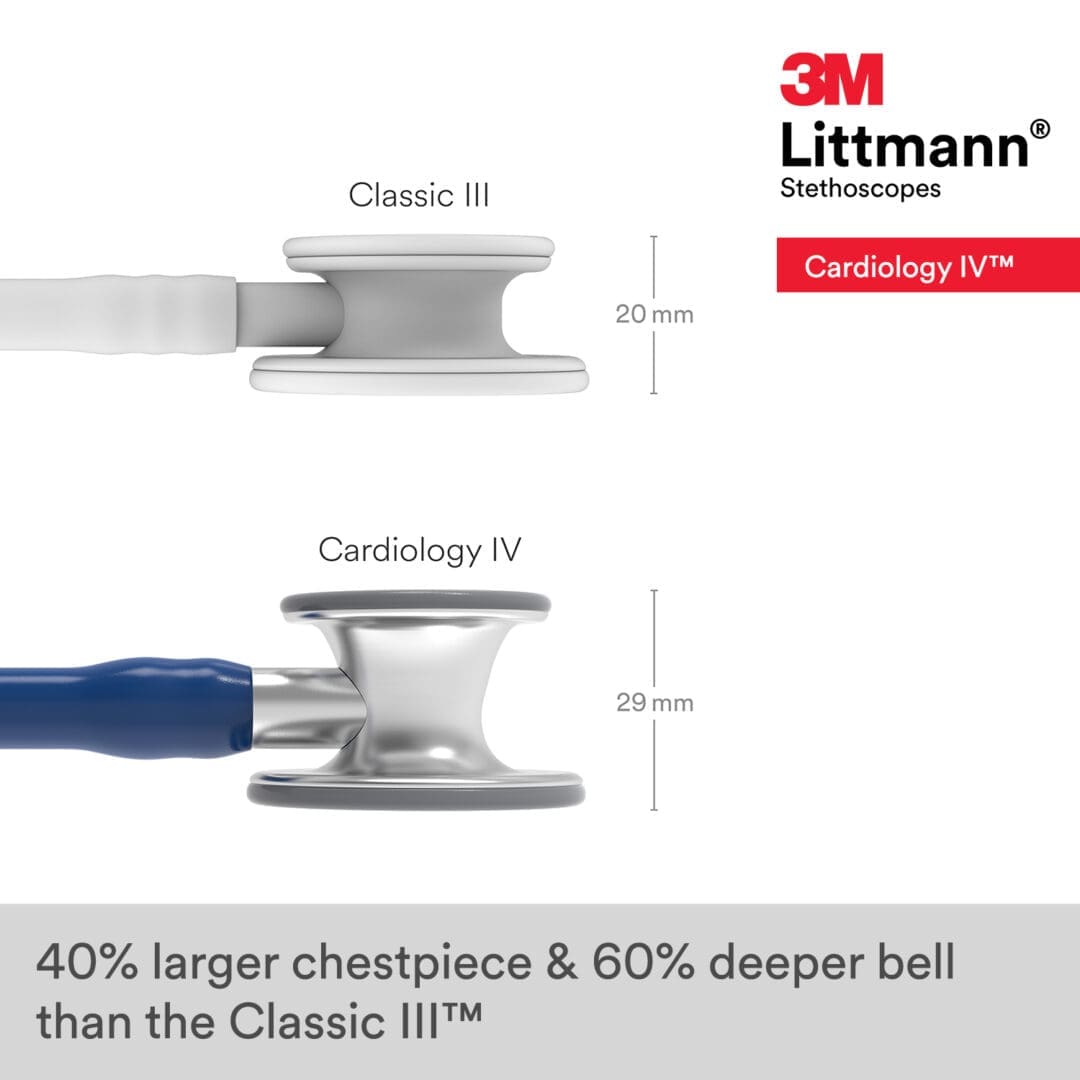
The Cardiology IV is the Classic III’s more advanced sibling. The acoustic performance is superior — it’s crisper, sharper, and better at picking up those subtle murmurs or barely audible crackles in a noisy ward environment. The dual-lumen tubing also reduces the “rubbing” noises you might notice with the Classic III, which makes auscultation feel smoother and more focused.
The chestpiece is larger and deeper, which also helps bring out those subtle frequency differences. For example, if you’re trying to distinguish between an aortic stenosis murmur and a flow murmur in a noisy AMU, you’ll appreciate the upgrade.
But these benefits come at a cost — both literally and figuratively. It’s heavier around your neck, which may not matter much for a few hours but can get a little annoying on long 12-hour shifts. And it’s expensive: usually £150–180 in the UK, almost double the Classic III. The warranty is longer (7 years), but the question you have to ask yourself is: Do I need this level of performance right now?
For those heading into cardiology, respiratory, or intensive care, the answer might well be yes. For the average medical student or foundation doctor, it’s probably not necessary.
What About Electronic Stethoscopes?
Then there’s the digital/ electronic Littmann stethoscopes, like the Littmann CORE. They can amplify sounds up to 40 times, cancel out background noise, and even record sounds so you can play them back or share them with colleagues. This is brilliant for teaching — imagine being able to replay a murmur for a group of students, or track changes in a patient’s lung sounds over time.
But are they worth it? For most students and junior doctors, the answer is no. At £300–400, they’re significantly more expensive than either the Classic III or Cardiology IV. They need charging, they’re bulkier, and while amplification sounds useful, it doesn’t replace the need to train your own ear. In exams, clinics, or day-to-day ward life, the basics are more than enough.
Where they do shine is in specialist practice, research, or teaching roles. If you’re particularly tech-savvy and love gadgets, you might enjoy having one — but for most early-stage doctors, they’re a “nice-to-have” rather than a “must-have.”
My Recommendation
If you’re a medical student or foundation doctor: go for the Classic III. It’s affordable, reliable, and will do everything you need it to do. You’ll learn just as much about murmurs and lung sounds on a Classic III as you would on a Cardiology IV — because the most important factor is not the stethoscope, but your training and repeated practice.
If you’re heading into a specialty where auscultation is key — like cardiology, respiratory, or ITU — then the Cardiology IV might be a sensible investment later down the line. Electronic stethoscopes are exciting, but realistically, they’re not necessary for the vast majority of students and juniors.
A Final Tip
Whatever model you choose, get your stethoscope engraved with your name. Hospitals are busy, stethoscopes get borrowed, and it’s far too easy to misplace them. Having your name or initials on the chestpiece means if you do lose it, it’s far more likely to find its way back to you. For a small cost, it gives you peace of mind — and keeps your stethoscope truly yours.
Drug of the week
Terbinafine
This is an allylamine antifungal that works by inhibiting the enzyme squalene epoxidase. It’s used both orally and topically.
This blocks the production of ergosterol, an essential component of the fungal cell membrane, while also causing a toxic build-up of squalene inside the fungal cell — ultimately leading to cell death.
Oral terbinafine is most often prescribed for onychomycosis (fungal nail infections) and tinea capitis (scalp ringworm), as it penetrates deep into the nail bed and hair follicles where topical treatments often fail.
Topical terbinafine, on the other hand, is used for more superficial infections like athlete’s foot, ringworm, jock itch, and pityriasis versicolor.
Side effects are usually mild, including gastrointestinal upset, headache, and skin rash.
Two important exam-worthy adverse effects to remember are hepatotoxicity (hence the need to check LFTs before starting long-term oral therapy) and taste disturbances, where patients may complain of a metallic taste or loss of taste altogether.
Rarely, renal impairment may also be an issue, so dose adjustments can be needed

A Brain Teaser
A 34-year-old female who is 16 weeks pregnant is found to have a raised serum alpha-feto-protein (AFP) and is concerned as to what may be the cause of this.
Which of the following may cause this patient to have a raised AFP?
A: Down’s syndrome
B: Omphalocele
C: Maternal diabetes mellitus
D: Edward’s syndrome
E: Maternal obesity
Answers
The answer is B – omphalocele
Omphalocele is a fetal abdominal wall defect which is associated with a raised maternal serum AFP. Down’s syndrome, maternal diabetes mellitus, Edwards syndrome and maternal obesity are all associated with low levels of maternal AFP.